Tuesday, May 08, 2007

Farrell Quinlan joins PRfect Media; Opens ‘In the Arena Public Affairs’

Quinlan becomes President of In the Arena Public Affairs

(Phoenix, AZ) PRfect Media announced today that Farrell A. Quinlan has joined the Valley-based public relations and advertising agency PRfect Media, as President of In the Arena Public Affairs, a wholly owned subsidiary of PRfect Media.

Quinlan served as spokesperson for the statewide business community for 10 years. Before joining In the Arena Public Affairs, Quinlan was Vice President of Policy Development and Communications for the Arizona Chamber of Commerce and Industry. Quinlan will bring his extensive experience to In the Arena Public Affairs including government relations; policy development and lobbying; media relations, coalition building and grassroots development; initiative, referendum and political action committee campaigns; political research and leadership; event management and strategic planning.

“This is a great opportunity for me. After a long time in association and chamber of commerce realms, I can now use my talents to build ‘In the Arena Public Affairs’ while having the infrastructure of PRfect Media behind me,” said Quinlan. “Having the backing of a full-service agency will give our clients a whole new level of service. We can provide government relations strategies from start to finish,” Quinlan said.

“Farrell’s qualifications and abilities are a tremendous combination that will help us launch an area of service that has long been in our sights. ‘In the Arena Public Affairs’ will be able to utilize the ‘all-inclusive’ atmosphere of PRfect Media along with the political expertise that Farrell provides,” said John Hernandez, CEO, PRfect Media.

In the Arena Public Affairs is currently working with a number of clients including Arizona Employers for Immigration Reform, a statewide organization working towards a fair immigration policy.

To arrange an interview or for more information on In the Arena Public Affairs, please contact Farrell Quinlan, President, In the Arena Public Affairs at (480) 706-6880 x126 or Ron Meritt, Chief Operating Officer, PRfect Media at (480) 706-6880 x121.

Tuesday, April 03, 2007

Media Interviews: How to Have a Great Experience Every Time

Speaking to the media presents a rare opportunity to get your views heard. However, it doesn’t need to be a stressful or frightening prospect. There are some common sense techniques and insights everyone should know before speaking to the media to have a successful, even fun, experience with the news media every time.

First, be prepared. Never wing it.

The first thing to remember when being interviewed by the media is not to wing it. Being immersed in a subject every day doesn't mean you can spontaneously move the right bricks into place to construct the foundation of a persuasive performance. If you are called by a reporter, you might want to try to schedule an interview with them later in the day, even an hour later, so you can do the necessary preparation. The reporter knows that you are busy. As long as you work within his deadline, he should respect your request to get back to him. Try to find out the subject matter he is calling about and what questions he would like answered. During your preparation, call on the people or resources who can help you with the issue area. Also, think about how you will respond to tough or hostile questions. Do you have a clear, honest and appropriate answer to the most negative question you can imagine? Imagine what a successful interview would look and sound like. Set out to make that a reality.

Determine what your message is or what you want to say.

There is usually a good reason a reporter is talking to you about a certain subject. You are being interviewed because you bring a particular perspective to the topic because of who you are, what you do or what you have done. Consider the one or two (but not more than three) ideas you want the reporter and, more importantly, the readers, listeners or viewers, to take from your comments. These messages should be short and to the point. You should be able to list these messages or the message in a clear and concise manner throughout the interview. Don’t worry about sounding like a “broken record.” Be comfortable repeating your message points over and over again.

Stay “on message” to avoid mistakes and gaffes.

When we hear about a politician, athlete or celebrity making a gaffe in the media, it is usually because they strayed from their message and allowed emotion to take over. Remember, reporters have a job to do. Part of that job is to write about interesting subjects. Controversy and conflict are inherently interesting. They may try to portray two sides of an issue as extremes and will look for quotes to support making their stories more controversial. By staying on message, even by repeatedly restating the main point of your argument with every answer to every question, you will avoid making gaffes and embarrassing or unhelpful remarks.

Try to “bridge” your answers back to your message points.

“Bridging” creates a transition so that you can move from the “question asked” to the message you want to communicate. This helps to deflect any attempts to derail your message. After answering the direct question, immediately transition to your message. Some key phrases to help accomplish this are; “What's important to remember, however…,” or “That's one way to look at it, but I think you'd be interested in knowing…” or “Let me put that in perspective…”

Don’t be afraid of saying “I don’t know.”

Most issues have many facets and the reporter will be speaking to many different sources. Don’t feel like you need to offer a comment on every aspect of a given issue. Understand why you are being interviewed and what perspective the reporter needs from you. If you are not a lawyer, don’t feel like you need to comment on legal issues outside your specific experience. The closer you keep your comments to what you know well, the less chance you will say something inaccurate or harmful to your position. Reporters know you don’t know everything. Don’t feel bad if you don’t know. Simply admit it. However, if there is information you should know, offer to get back to them with the information before their deadline. If you know someone on your side of the issue that can answer the question, offer to put the reporter in touch with that person.

Stop talking after you answer the question.

One of the most effective techniques in journalism is to just sit there and let the interviewee talk. They may ask a question to start the conversation and then let you go on and on. They may throw in a supportive “question” or “minimal encourager” here or there to keep you talking. Don’t confuse this with you having control over the interview. Most try to avoid awkward pauses in conversation. They make us uncomfortable and we usually try to fill in those gaps by talking. In an interview with a reporter, do not give in to the impulse to fill in those conversation gaps. That’s when you will most likely go off message and make embarrassing or damaging statements that get quoted and misrepresent your true sentiments and position. Stop when you are done answering the question. Just stop. Take a sip of your drink. Smile. Pet the dog. Anything. Just don’t continue answering the question. The reporter will move on.

Answer the question you want to answer, not the question they ask.

Don’t allow the reporter to totally dictate the terms of the interview. Answer all the questions, but stay “on message.” Don’t get frustrated if you are asked the same question multiple times. Often reporters will frame a question in a way that asserts a premise that you do not believe or that is damaging to your position. Reject the premise. Even go so far as to ask your own version of the question and answer it. Reporters don’t do this to be mean or to show bias. They do this to draw out an emotional response that might more accurately reflect your heartfelt views rather than a rehearsed statement. However, just because you are prepared and have a well-reasoned argument, it doesn’t mean you are being dishonest or hiding something. An emotional response might be good copy for a newspaper article or a sound bite for a radio or TV report, but it rarely reflects your views accurately.

The reporter is not your friend.

In any media interview, you are really speaking through the reporter to his or her readers, listeners or viewers. Having a good relationship with the reporter is positive. However, the success of your performance is judged by how it impacts the audience, not necessarily the reporter.

Be positive and confident throughout the interview.

When speaking to the media, be helpful and stay relaxed. If you are nervous or this is your first time talking to a reporter, it’s okay to say so (just not on the air or on camera though). A good reporter wants to get the story, not embarrass you. Listen carefully to the question. Take a few seconds to breathe and frame your answer. Speak slowly and avoid jargon. Speak with confidence and enthusiasm. Smile when you speak. Even if they can't see you, the smile and good will come through.

Stay “on the record,” it’s better to be safe than sorry.

Have the attitude that nothing is ever off the record. Assume that anything you say or give them could end up in the story. Also, be careful making jokes or using sarcasm. Things said out load often don’t seem as humorous transcribed onto a cold sheet of paper.

Seeing your name in the paper or your face on television should be fun. Relax, enjoy yourself. But take the experience seriously. Following these common sense guidelines can demystify the experience and ensure that talking to the press will be a positive experience.

Farrell Quinlan is a public relations and government affairs consultant in Chandler, Arizona. He has been a journalist, political operative, congressional staffer and for a decade was the vice president of communications and lobbyist for the Arizona Chamber of Commerce and Industry.

Sunday, April 01, 2007

2007 Major League Baseball Predictions

NATIONAL LEAGUE
NL East: New York Mets
NL Central: Chicago Cubs
NL West: Arizona Diamondbacks
NL Wild Card: Los Angeles Dodgers
NL Champion: New York Mets
NL MVP: Carlos Beltran, New York Mets
NL Cy Young: Brandon Webb, Arizona Diamondbacks
NL Rookie: Chris B. Young, Arizona Diamondbacks
NL Manager: Lou Pinella, Chicago Cubs
NL Batting Champ: Miguel Cabrera, Florida Marlins (.350 range)
NL HR Champ: Ryan Howard, Philadelphia Phillies (more than 50)

AMERICAN LEAGUE
AL East: Boston Red Sox
AL Central: Detroit Tigers
AL West: Los Angeles Angels of Anaheim
AL Wild Card: New York Yankees
AL Champion: New York Yankees
AL MVP: Vladimir Guerrero, Los Angeles Angels of Anaheim
AL Cy Young: Johan Santana, Minnesota Twins
AL Rookie: Alex Gordon, Kansas City Royals
AL Manager: Mike Scioscia, Los Angeles Angels of Anaheim
AL Batting Champ: Ichiro, Seattle Mariners (challenges .400)
AL HR Champ: Alex Rodriguez, New York Yankees (more than 50, more then Ryan Howard)

World Series Champion: New York Mets

Miscellaneous:

  • Barry Bonds hits 34 HR breaking Hank Aarons’ career mark.
  • Roger Clemens returns to the Houston Astros, is injured, retires for good
  • Johan Santana wins more than 25 games
  • Alex Rodriguez silences critics in NY with monster season and playoffs (.310 BA, 55 HR, 145 RBI, 30 SB), opts for free agency at end of season anyway
  • Randy Johnson shows flashes of his old self (15 W, 200 K, 3.25 ERA)
  • Sammy Sosa hits 25 HRs with 80 RBI but has a low BA (.240s)
  • Mike Sweeney stays off the DL and has nice comeback season

Saturday, March 31, 2007

BOOK REPORT: “Jim Cramer's Mad Money: Watch TV, Get Rich” by James J. Cramer and Cliff Mason

Jim Cramer's Mad Money: Watch TV, Get Rich” by James J. Cramer and Cliff Mason is a quick read and a very good companion to the CNBC show of the same name. Cramer does have the wild man schitck going but as the "most sincerely insenere man in America" he has fun with it while offering great insite into the market for us little guys. I bought the book because I watch the show, so I was able to get into a lot of the inside baseball about the show that is present throughout the book. I'm not sure how much this will annoy or totally confuse readers who don't watch the show. I suspect it would be a negative. Overall, I liked the book. But it's short with a little too much padding. If you like Cramer and his personality, I recommend it. If not, watch the show for a week and then decide if you want more Cramer.

Friday, February 09, 2007

BOOK REPORT: “Dangerous Nation” by Robert Kagan

Robert Kagan’s “Dangerous Nation” is a very interesting and valuable book. It challenges the conventional wisdom that America’s foreign policy since the Revolutionary War has been essentially isolationist in character steeped in realpolitick and self-interest. Instead, he makes a compelling case that the United States has deep idealistic tendencies and more often than not has been driven by those ideological factors rather than cold-blooded realism.

The book is the first of two volumes. It ends right after the declaration of war on Spain in April 1898. The run up to that war is extensively covered while the Mexican War fifty years prior gets short shrift. Go figure.

What I found most fascinating about the book is the complete pollution of practically all of the United States’ institutions by the issue of slavery. This book focuses on foreign policy and the grotesque distortions that slavery imposed on our nation’s early foreign policy but I was struck by the total subsuming of the Democratic Party in the issue prior, during and even after the Civil War.

I look forward to the second part. Let’s hope it comes sooner than the 10 years Kagan says he spent writing this book.

Monday, February 05, 2007

Korkes lands construction industry post

By Mike Sunnucks
The Business Journal
January 26, 2007

A former lobbyist for the Arizona Chamber of Commerce & Industry landed a post at a statewide construction industry group.

Romina Korkes has been hired as the new government affairs director at the Arizona Contractors Association.

Korkes previously was public affairs director for the state chamber, which has undergone wholesale personnel changes in recent months.

The contractors group is one of the more politically moderate business groups in the state and has warm relations with Democratic Gov. Janet Napolitano.

The ACA also promoted Brett Jones to vice president. Jones previously served as the group's lobbyist.

Korkes is one of a number of staff members to leave the Arizona Chamber recently. Vice President Farrell Quinlan stepped down earlier this month to start his own public relations and lobbying outfit. Lobbyist Scott Peterson quit to take a government relations job in Wisconsin. Former chamber Chief Executive Jim Apperson resigned last year and now is a top budget adviser to Napolitano.

Apperson, a Democrat, was replaced by Glenn Hamer, the former executive director of the Arizona Republican Party. Hamer's appointment and state chamber Chairman Steve Twist's strong ties to the Republican Party sparked some consternation with the governor's office and Democrats -- including chief of staff Dennis Burke -- who said the chamber is becoming partisan.
Since taking over at the chamber, Hamer has stressed that he is committed to a nonpartisan, pro-business, pro-growth agenda.

Get connected

Arizona Contractors Association: www.azca.com
Arizona Chamber of Commerce & Industry: www.azchamber.com

Wednesday, January 24, 2007

Sign the NRSC Pledge

I have signed and I urge everyone who supports victory in Iraq to sign, the following pledge:

If the United States Senate passes a resolution, non-binding or otherwise, that criticizes the commitment of additional troops to Iraq that General Petraeus has asked for and that the president has pledged, and if the Senate does so after the testimony of General Petraeus on January 23 that such a resolution will be an encouragement to the enemy, I will not contribute to any Republican senator who voted for the resolution. Further, if any Republican senator who votes for such a resolution is a candidate for re-election in 2008, I will not contribute to the National Republican Senatorial Committee unless the Chairman of that Committee, Senator Ensign, commits in writing that none of the funds of the NRSC will go to support the re-election of any senator supporting the non-binding resolution.

Click here to sign the pledge too.

Wednesday, January 17, 2007

The Arizona Republic's Business Buzz


“The amount of growth and change in Arizona over the last decade has been remarkable. But in so many ways, we have kept that small town feel. Sometimes that’s good, sometimes not so much.”

Farrell Quinlan
Former vice president policy development and communications at the Arizona Chamber of Commerce and Industry, who resigned Monday after 10 years as spokesman for the state’s business community.

Longtime VP Quinlan leaves Arizona Chamber

The Business Journal of Phoenix – Monday, January 15, 2007
by Mike Sunnucks
The Business Journal

Arizona Chamber of Commerce & Industry Vice President Farrell Quinlan is stepping down from that post.

Quinlan has been with the state chamber of commerce for 10 years and has been a leading spokesman for the business community at the state Capitol.

Quinlan is not disclosing his next career move. His last day was Jan. 15.

The state chamber is a leading statewide business advocate. It has undergone some leadership and staff changes recently with former Arizona Republican Party Director Glenn Hamer taking over for Jim Apperson late last year.

Apperson, a Democrat, went to work as a senior budget adviser to Gov. Janet Napolitano. Hamer's hiring at the state chamber sparked a spat between the business group and the Democratic governor's office.

The chamber has lobbied for tax cuts, unemployment insurance reforms and immigration reforms in recent years.

Hamer applauded Quinlan's work with the chamber including media relations, advocacy and event management. He said a replacement has not yet been named.

Quinlan leaves Arizona Chamber after a decade of service to statewide business association

Farrell A. Quinlan’s last day on the staff of the Arizona Chamber of Commerce and Industry is Monday, January 15, 2007. He has been a vice president of the organization for a decade, most recently serving as Vice President of Policy Development and Communications.

Quinlan is not ready to make an announcement concerning his next career opportunity. He has a number of options available to him in organizational management, government relations and public relations in Arizona and nationally.

Quinlan has served as spokesperson for the statewide business community for 10 years. He has been a key developer and implementer of a wide-range of organizational initiatives including: media relations; government relations, policy development and lobbying; coalition building; initiative, referendum and political action committee campaigns; political research; strategic planning; marketing; event management and messaging.

Highlights of his tenure include:

Media Relations: Quinlan has been quoted regularly in Arizona and national press on a wide-range of political and business topics. His opinion pieces and on-the-record comments have appeared in numerous print media outlets including the New York Times, Wall Street Journal, Washington Post, Christian Science Monitor, Arizona Republic, Arizona Daily Star, The Business Journal, Congressional Quarterly, East Valley Tribune, Los Angeles Times, Tucson Citizen, Phoenix Magazine, Inside Tucson Business, Arizona Capitol Times, Washington Times, Campaigns & Elections, Bloomberg and the Associated Press. He has been an expert guest or official spokesman on numerous broadcast media programs including FOX News Channel, Voice of America, National Public Radio’s All Things Considered, The Hugh Hewitt Show, Horizon (KAET-TV), Face the State (KSAZ-TV), The Phoenix File (KUTP-TV), The Barry Young Show (KFYI-AM), The Liddy & Hill Show (KFYI-AM), Business for Breakfast (KFNN-AM), KJZZ-FM, KNST-AM, KPXQ-AM and KTAR-AM.

Comprehensive Immigration Reform: Quinlan was responsible for the Arizona Chamber initiating an immigration policy stakeholder process in the Summer of 2003 that culminated in the organization’s leadership in opposing 2004’s Proposition 200 and the creation of a comprehensive immigration reform agenda for the statewide business community. Through his efforts, the Arizona Chamber has received national recognition for its early identification and proactive approach to immigration reform issues. He is a much sought after spokesperson on state and federal immigration issues having appeared on the Fox News Channel, National Public Radio and numerous Arizona outlets as well as in leading national publication like the Washington Post, New York Times and the Wall Street Journal. He has served on the U.S. Chamber of Commerce’s Labor Relations Committee and its Immigration subcommittee since 2004.

Policy Development and Lobbying: Before launching the Arizona Chamber’s immigration policy efforts, Quinlan received national recognition for creating a top state-level lobbying effort to urge Arizona’s congressional delegation to vote in favor of extending normal trade relations to China and clearing the way for accession of China into the World Trade Organization. He served as the organization’s Federal Affairs representative and worked closely with the U.S. Chamber of Commerce in their many initiatives on trade, workplace regulation and taxation. Quinlan managed the public policy development process at the organization for an eclectic mix of policy areas including air quality; banking; economic development; education; employee relations; energy; environment; government reform; health care; immigration; infrastructure; insurance; legal affairs; natural resources; solid and hazardous waste; state budget; taxation; technology; trade; transportation; water quality and quantity; and workforce development. He was registered with the Arizona Secretary of State’s office as an authorized lobbyist for the Arizona Chamber 1997-2007.

Coalition Building and Grassroots Development: Quinlan has been the point man at the Arizona Chamber in building permanent and limited organizational coalitions to support policy initiatives, legislation and political campaigns. Some of the issue areas where he has organized such coalitions include health care, property tax reduction, immigration reform and unemployment insurance reform. He also introduced the idea of formalizing the loose relationship between the state chamber of commerce and the scores of local chambers across the state into a standing committee of the Arizona Chamber. This Local Chambers Committee meets every week during the legislative session to discuss the business community’s legislative priorities and coordinate lobbying and grassroots efforts to support it. He has also developed grassroots lobbying strategies that include the creation of a 40,000-strong Arizona business database and the creation of web-based grassroots tools to communicate with congressional and state policymakers on critical issues for business.

Political Leadership: Quinlan has served on the steering committees and as a fundraiser for numerous ballot proposition campaigns, political action committees and independent expenditure efforts. Most notably: 2006’s Proposition 202 (against) establishing a state minimum wage, 2006’s Proposition 207 (in favor) eminent domain reform, 2004’s Proposition 101 (in favor) limiting state spending by ballot proposition, 2004’s Proposition 104 (in favor) initiative reform, 2004’s Proposition 200 (against) anti-immigration efforts, 2000’s Proposition 202 (against) growth boundaries. He has established and maintained standing political action committees for the Arizona Chamber including Arizona Chamber PAC and an independent expenditure committee, BizPAC, for which he served as treasurer for both. In his capacity as spokesperson for the Arizona Chamber, Quinlan has been a regular protagonist in print and broadcast media advocating the business community’s position on dozens of controversial political and legislative topics.

Political Research: Quinlan has long been an advocate of developing a robust political research effort at the Arizona Chamber and elsewhere. Early in his career, he served as a research intern for members of Congress and as an opposition research operative for the Republican National Committee during a presidential election year cycle. At the Arizona Chamber, Quinlan worked to build a policy research and analysis capability for the organization that included the development of a 501(c)(3) foundation to concentrate resources on providing the business community with valuable data to inform policy development. He has also had extensive experience developing and analyzing market research and polling instruments.

Event Management: Quinlan successfully integrated the Arizona Chamber events lineup into a coordinated package of old and new events that supported the public policy mission of the organization and tripled the gross income from events to over $500,000 annually. The annual gala Arizona Heritage Award dinner, annual golf classic and numerous issue-specific policy seminars (five Western Energy Summits, five Arizona Health Care Summits, eight Arizona Environmental Law Symposia, employment law seminars, an immigration reform summit and a litigation reform summit) all achieved new heights in attendance, profitability and relevance under Quinlan’s management. He also created the Arizona Chamber’s popular VIP speakers series that featured gubernatorial and congressional candidate debates, congressional and presidential candidate breakfasts or luncheons and events with Cabinet secretaries, Fortune 500 CEOs and Nobel Prize laureates.

Strategic Planning: As a senior executive staff member of the Arizona Chamber, Quinlan has been a key contributor to strategic planning and development for the organization covering marketing, membership, board recruitment and development, events, government relations and public relations.

Marketing and Branding: Quinlan has twice lead efforts to re-brand the organization including the most recent changes in 2005 that resulted in the changing of the organization’s name to the Arizona Chamber of Commerce and Industry to better reflect the width and breath of the group’s membership and public policy focus. Both efforts included the adoption of new logos and the development and relaunch of the www.azchamber.com website.

Community and Civic Involvement: A graduate of The George Washington University in Washington, D.C. with a bachelor of arts in political communication, Quinlan is involved in many community and civic groups. Most notably: Gov. Janet Napolitano appointed him to serve on the Arizona State Quarter Commission, which is charged with developing the design of the U.S. Mint’s 2008 Arizona quarter and organizing the special coin’s rollout ceremonies in May 2008; he serves on the board of directors of Drugs Don't Work in Arizona!, a drug-free workplace initiative; and, on the advisory board of the Arizona School Choice Trust, which awards private school scholarships to needy K-12 students. He is also active in the Republican Party, serving as precinct committeeman and as Legislative District 20 2nd Vice Chairman. Quinlan and his wife Heidi live in Chandler with their two dogs (an Akita and a Pembroke Welsh Corgi).

Friday, December 29, 2006

CRITIQUE & REVIEW: “Night at the Museum" a hoot


Night at the Museum is a very entertaining movie with a neat concept. But I am left with the feeling that they could have done so much more with it. The movie will most likely make a bunch of money and require a sequel. Maybe in that movie they can really get into the idea of inanimate objects coming to life after hours in a deeper way. It is well worth the money to see it on the big screen but a wait for DVD is fine.


Look: 8
Story: 5
Acting: 7
Goal: 7.5
Intangibles: 6
Overall: 7
_____________________________________

The above scores are based on a 10-point scale.

  • Look has to do with the visual artistry of the film.
  • Story rates the how compelling the film’s plot is.
  • Acting rates the overall performances of the actors.
  • Goal measures the success of the film at accomplishing its goal… does a comedy make you laugh, does a thriller cause goose bumps.
  • Intangibles score any special circumstances or accomplishments the movie deserves to be recognized for.
  • Overall rating is not an average of the other categories, just this reviewer’s impression of the entire work and how I would rate the film to a friend.

CRITIQUE & REVIEW: “Apocalypto" Oscar-worthy?


Mel Gibson’s Apocalypto is a very good movie, perhaps Oscar-worthy. It is very violent and gory, like the Mayan civilization it depicts. No-name actors, foreign (practically dead) language and an alien environment present average moviegoers with a lot of barriers to plunking down their movie dollars. But all who can stomach (honest) depictions of human sacrifice and the proverbial "man’s inhumanity to man" should see this fast paced and suspenseful chase movie. It is well worth the money to see it on the big screen but a wait for DVD is fine.

Look: 8.5
Story: 7
Acting: 8
Goal: 9
Intangibles: 9
Overall: 8.5
_____________________________________

The above scores are based on a 10-point scale.

  • Look has to do with the visual artistry of the film.
  • Story rates the how compelling the film’s plot is.
  • Acting rates the overall performances of the actors.
  • Goal measures the success of the film at accomplishing its goal… does a comedy make you laugh, does a thriller cause goose bumps.
  • Intangibles score any special circumstances or accomplishments the movie deserves to be recognized for.
  • Overall rating is not an average of the other categories, just this reviewer’s impression of the entire work and how I would rate the film to a friend.

Saturday, December 02, 2006

CRITIQUE & REVIEW: “Borat...," A Date Movie? NOT!


Borat: Cultural Learnings of America for Make Benefit Glorious Nation of Kazakhstan is a very funny and offensive movie that is only for the people who will "get it." Borat's creator Sacha Baron Cohen is a comic genius. I only hope that the wrestling shown really was fake like the professional varity. It's a "guy movie" that the ladies will most likely not appriciate. Not a date movie.

Look: 3
Story: 5
Acting: 8
Goal: 9
Intangibles: 7
Overall: 7
_____________________________________

The above scores are based on a 10-point scale.

  • Look has to do with the visual artistry of the film.
  • Story rates the how compelling the film’s plot is.
  • Acting rates the overall performances of the actors.
  • Goal measures the success of the film at accomplishing its goal… does a comedy make you laugh, does a thriller cause goose bumps.
  • Intangibles score any special circumstances or accomplishments the movie deserves to be recognized for.
  • Overall rating is not an average of the other categories, just this reviewer’s impression of the entire work and how I would rate the film to a friend.

CRITIQUE & REVIEW: "Happy Feet" is sad


Happy Feet is a gorgous-looking movie with a very forgettable PC-friendly, anti-human plot. Wait for it to come out on cable.

Look: 10
Story: 3
Acting: 3
Goal: 3
Intangibles: 3
Overall: 4
_____________________________________

The above scores are based on a 10-point scale.
  • Look has to do with the visual artistry of the film.
  • Story rates the how compelling the film’s plot is.
  • Acting rates the overall performances of the actors.
  • Goal measures the success of the film at accomplishing its goal… does a comedy make you laugh, does a thriller cause goose bumps.
  • Intangibles score any special circumstances or accomplishments the movie deserves to be recognized for.
  • Overall rating is not an average of the other categories, just this reviewer’s impression of the entire work and how I would rate the film to a friend.

Sunday, November 12, 2006

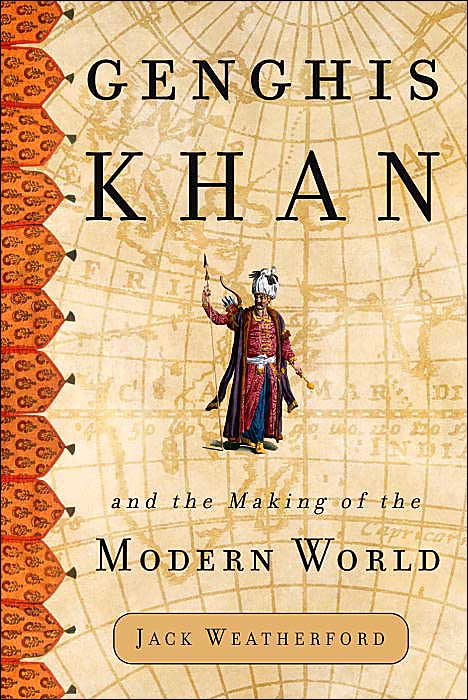
BOOK REPORT: “Genghis Khan and the Making of the Modern World” by Jack Weatherford


In "Genghis Khan and the Making of the Modern World", Jack Weatherford does a great service to the resuscitation of the 13th Century Mongol conqueror’s reputation and legacy. Genghis Khan is often depicted in popular and academic writings as a bloodthirsty savage who relished the acts of torture and genocide. Weatherford’s Genghis Khan is a misunderstood genius who created an empire that was in many ways centuries ahead of the ones created by Chinese, Muslim and European civilizations that the Mongols subjugated.

Genghis Khan created a new nation after decades of war within the areas we call Mongolia and Inner Mongolia (a part of China). The nomads of the steppe had always clung to their tribal identities and when one of them grew too strong, the sedentary civilizations of China and Central Asia conspired to pit one tribe against another. Genghis Khan broke this pattern and instead forced the sedentary civilizations to conform to his interests and will. He did so by placing merit above birth in choosing his generals. Women enjoyed far greater rights and freedom under Mongol laws than under any of the civilizations they conquered.

Perhaps what distinguishes Genghis Khan over other conquerors was the remarkable durability of his empire. Though the greatest conqueror of all time in terms of landmass, Genghis Khan’s heirs continued the Mongol conquests and subjugated Russia (1240s), Iran and Iraq (1250s) and China (1260s-1270s) and instituted a century-long Pax Mongolica, or Mongol peace, that drove civilizational contact among Europe, India, China and the Middle East.

In fact, Weatherford makes a strong case that it was this very commercial and cultural exchange that sustained Mongol power long after they had grown soft and their military edge had waned. He also makes a strong case that the Black Death that arrived in Europe in 1347 from Mongol Russia had in the decade before done what no army of man had been able to do, disburse and ultimately end the Mongol Empire. Once the devastation and depopulation of the plague had cut the connections between faraway nations, native subjects throw off their Mongol overlords and the Mongol Empire evaporated. By the 1380s, direct Mongol power was limited to the steppe.

Weatherford does a very good job of making the (very) foreign Mongol and Asian geography and languages accessible to American readers. He also does not get bogged down with every significant flair up in Mongol politics (Golden Horde vs. Ilkhan wars, etc.) while providing enough detail to let readers know and understand the major fault lines within imperial Mongol politics.

Since 2006 is the 800th anniversary of the election of Temujin as "Genghis Khan" and the creation of the Mongol state in 1206, it is fitting that we have such a valuable and easy to read book as Weatherford’s to instruct us. I highly recommend this book to novices and history buffs alike.

Thursday, November 09, 2006

65% Accuracy Rate in 2006 Election Predictions

I was right that Democrat incumbent Gov. Janet Napolitano would cruise to victory but I was wrong that Republican gubernatorial candidate Len Munsil would break through the 40% barrier… very pathetic showing for a red state. Munsil’s percentage statewide wasn’t higher than nativist GOP CD8 nominee Randy Graf's total in his district.

I was also wrong that CD5 incumbent J.D. Hayworth (R) would best Harry Mitchell (D).

Sen. Jon Kyl beat Democrat Jim Pederson by 9 points rather than my predicted 6 percent... I’m counting that as a right prediction.

Arizona Propositions:

Right -- Proposition 100 wins.
Wrong (maybe) -- Proposition 101 loses. It’s very close, still waiting on all early ballots to be counted
Right -- Proposition 102 wins.
Right -- Proposition 103 wins.
Right -- Proposition 104 wins.
Right -- Proposition 105 loses.
Right -- Proposition 106 loses.
Wrong -- Proposition 107 wins. Amazing, the first state in the nation to reject a Marriage Protection Amendment. Proponents over-reached and voters did not want to take away existing domestic partner benefits.
Right -- Proposition 200 loses.
Right -- Proposition 201 wins.
Right -- Proposition 202 wins.
Right -- Proposition 203 wins.
Right -- Proposition 204 wins.
Wrong -- Proposition 205 wins. Wow. The goofy Prop. 200 voter lottery question did better than this one.
Wrong -- Proposition 206 wins (with more votes than Proposition 201.) I guess those disclosure requirements that highlighted R.J. Reynolds’ support sunk this one despite the $8+ million spent by them.
Right -- Proposition 207 wins.
Right -- Proposition 300 wins.
Right -- Proposition 301 wins.
Right -- Proposition 302 loses.

My prediction that the “big story of the evening” would be that the GOP would do better than expected. Well, move along, nothing to see here.

Maryland GOP Senate nominee Mike Steele did not win and take a Democratic Senate seat.

PA’s Santorum, OH’s DeWine, RI’s Chafee did all lose GOP seats. But so did MO’s Talent, MT’s Burns and VA’s Allen. I was right on TN’s Corker holding a GOP seat. So my Democratic net gain of 2 in the U.S. Senate was short by 4.

Democrats did take the U.S. House and with more than my predicted 20-seat pick up... I’m counting that as a right prediction.

AZ’s John Shadegg is running for minority whip. That prediction still might come to fruition.

So as I count it, I was right on 22 of 34 prediction with the Shadegg leadership pick still outstanding.

Tuesday, November 07, 2006

Election 2006 Predictions


Here are my prediction on the 2006 elections.

Republican gubernatorial candidate Len Munsil breaks through the 40% barrier but Democrat incumbent Gov. Janet Napolitano cruises to victory.

Munsil’s percentage statewide will be higher than GOP CD8 nominee Randy Graf's total in his district.

CD5 incumbent J.D. Hayworth (R) squeaks by Harry Mitchell (D).

Sen. Jon Kyl beats Democrat Jim Pederson by 6 percent.

Arizona Propositions:

Proposition 100 wins.
Proposition 101 loses.
Proposition 102 wins.
Proposition 103 wins.
Proposition 104 wins.
Proposition 105 loses.
Proposition 106 loses.
Proposition 107 wins.
Proposition 200 loses.
Proposition 201 wins.
Proposition 202 wins.
Proposition 203 wins.
Proposition 204 wins.
Proposition 205 wins.

Proposition 206 wins (with more votes than Proposition 201.)
Proposition 207 wins.
Proposition 300 wins.
Proposition 301 wins.

Proposition 302 loses.

Big story of the evening: GOP does better than expected.

Maryland GOP Senate nominee Mike Steele wins taking a Democratic Senate seat.

PA’s Santorum, OH’s DeWine, RI’s Chafee will lose GOP seats. MO’s Talent, MT’s Burns, VA’s Allen and TN’s Corker hold GOP seats. Democratic net gain of 2 in the U.S. Senate (maybe 3 with Burns going down, if 4 then its Talent going down too)

Democrats take the U.S. House but with a 20 or fewer seat pick up.

AZ’s John Shadegg will be elected GOP Leader, probably the minority leader before the year is out.

Sunday, November 05, 2006

Proposition 205 TV Debate

I was featured this week on Phoenix Channel 3's coverage of the 2006 Elections. The issue, the vote-by-mail Proposition 205. The Arizona Chamber is opposed. I debated initiative sponsor Rick Murphy.

Click here to see the debate.

San Francisco Chronicle: "Arizona plan offers chance to cast a vote, win a million"

I was interviewed late last week by the San Fransisco Chronicle on Arizona's nutty Proposition 200 concerning a million-dollar voter lottery.

"We believe it's an insult to Arizona voters to say we have to bribe them to vote,' said Farrell Quinlan, a spokesman for the Arizona Chamber of Commerce and Industry, which opposes the measure. "It will make Arizona the laughingstock of America if it passes."
Read the entire article here.

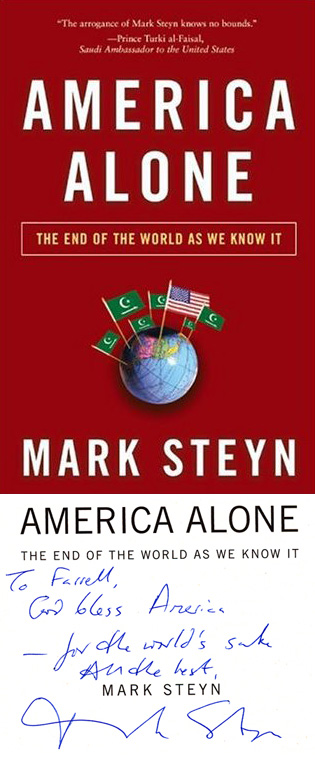
BOOK REPORT: "America Alone: The End of the World as We Know It" by Mark Steyn

Mark Steyn’s "America Alone: The End of the World as We Know It" is must reading for everyone, especially those who are confronted by soft-headedness over our struggle with Islamist terror. Steyn goes through the chilling statistics of how Europe and other secular societies are evaporating without a fight. With a birthrate of 1.1 children per women, Italy will half its native population in a generation. So without even confronting the sophisticated military hardware of the West, Islamist can wait us out and move in while Europeans give up and die off.

Coupled with Dore Gold's "Hatred's Kingdom," we get a clear picture of the radical Wahhabists' past, present and future plans for the world.

In the following lengthy excerpt, Steyn believes there are "three possible resolutions to the present struggle:"
  1. Submit to Islam
  2. Destroy Islam
  3. Reform Islam

Because most of us don't take number one as a serious possibility, we're equally unserious about being forced to choose between two and three. But submission to Islam is very possible, and to many it will still seem ridiculous even as it happens; like John Kerry during the 2004 campaign, we'll be spluttering that we can't believe we're losing to these idiots. But we can lose (as I've always believed) and (as I've come to believe) we might lose more easily than even the gloomiest of us thought.

By "we might lose," I mean "the good guys" -- and I define that term expansively. There are plenty of good guys in Australia and Poland and Iraq and even Pakistan. And I'm a little unnerved at the number of readers who seem to think the rest of the world can go hang but America will endure as a lonely candle of liberty in the new Dark Ages. Think that one through: a totalitarian China, a crumbling Russia, an insane Middle East, a disease-ridden Africa, a civil war-torn Eurabia -- and a country that can't even enforce its borders against two relatively benign states will somehow be able to hold the entire planet at bay? Dream on, "realists."

As for option two, it doesn't bear thinking about. Even if you regard Islam as essentially incompatible with free societies, the slaughter required to end it as a force in the world would change America beyond recognition. That doesn't mean that, a few years down the line, if some kooks with nukes obliterate, say, Marseilles or Lyons that the French wouldn't give it a go in some fairly spectacular way. But they're unlikely to accomplish much by it, any more than the Russians have by their scorched-earth strategy in Chechnya.

That leaves option three: Reform Islam -- which is not ours to do. Ultimately, only Muslims can reform Islam. All the free world can do is create conditions that increase the likelihood of Muslim reform, or at any rate do not actively impede it. We can:

  1. Support women's rights -- real rights, not feminist pieties -- in the Muslim world. This is the biggest vulnerability in Islam. Not every Muslim female wants to be Gloria Steinem or Paris Hilton. But nor do they want a life that starts with genital mutilation and ends with an honor killing at the hands of your brothers. The overwhelming majority of females in Continental battered women's shelters are Muslim -- which gives you some sense of what women in the Middle East might do if they had any women's shelters to go then half the population of these societies is a potential source of dissent, we need to use it.
  2. Roll back Wahhabi, Iranian, and other ideological exports that have radicalized Muslims on every continent. We have an ideological enemy and we need to wage ideological war.
  3. Support economic and political liberty in the Muslim world, even if it means unsavory governments: an elected unsavory government is still better than a dictatorial unsavory government. It's not necessary for Syria and Egypt to become Minnesota and New Zealand. All that's necessary is for them to become something other than what they are now. And on the bumpy road to liberty, every Muslim regime that has to preoccupy itself with internal dissent has less time to foment trouble beyond its borders.
  4. Ensure that Islamic states that persecute non-Muslims are denied international legitimacy and excluded and marginalized in international bodies.
  5. Throttle the funding of mosques, madrassas, think tanks, and other activities in America and elsewhere by Saudi Arabia, Iran, and others.
  6. Develop a strategy for countering Islamism on the ideological front. Create a civil corps to match America's warrior corps and use it to promote alternative institutions, structures, and values through a post-imperial equivalent to Britain's Colonial Office, albeit under whatever wussy name is deemed acceptable: Department of Global Community Outreach or whatever (this, by the way, is what Washington should have created instead of the bloated bureaucracy of the Department of Homeland Security).
  7. Marginalize and euthanize the UN, NATO, the International Atomic Energy Agency, and other September 10 transnational organizations and devote the energy wasted on them to results-oriented multilateralism. We need real allies now.
  8. Cease bankrolling unreformable oil dictatorships by a long overdue transformation of the energy industry.
  9. End the Iranian regime.
  10. Strike militarily when the opportunity presents itself.

Aside from numbers nine and ten, these are important but undramatic objectives -- i.e., the kind of stuff our side does very badly. The problem with redesignating the "war on terror" as "the long war" is that it's easy for it to degenerate a step further and lapse into non-war mode entirely.